At the end of our hour, she told me that although I’ve been hurt and broken badly, she can see I still have parts that aren’t shattered.
I laughed lightly and I said “Yeah, one day that will be all of me, no parts shattered anymore”,
And she said “No, it won’t.”
And, for a second, I felt my heart break – but she continued.
“But it will be the most dominant part of you. Think of your body – if you break your shoulder, even after it heals it will be tender. It will be a sore spot. You will be careful with it. There will be a gentleness when you care for it. If you crack a rib, laughing will hurt and, even after there is no longer a fracture, you may laugh lighter just in case. You can heal, but it is okay to be aware of the parts of you that once hurt the most. The most important thing to know is that where there is tenderness, let there be gentleness.”
I’m taking a bit of a break from Tumblr to recharge and find some positivity in my life! I’ll also be on a trip for a portion of next week so I would’ve been gone anyways.
I will be back by October 9th at the latest!
I’ll bump my (untagged) queue up to 10 posts a day so it’ll be like I’m still here, just with less personal posts.
It is on these cold days, where the dim light grows ever stronger and the woods seem to sigh in the evening’s early twilight, that I find myself thinking about the edges of the landscape. That subtle form that is just beyond our reach, just outside of our touch. Those moments we linger at the edge of a glade, or near a fallen tree in the bracken. Hearing the silence that is full of noise, a quiet rush of unexpected sounds hiding under the frequencies of our breath, behind the rustle of the leaves, taunting us from the treetops and river’s edge like a youthful lover.
The walks I take are often accompanied by my pipe. Full of some herbs gathered here or there depending on the time of year (and never tobacco). One herb that I find helps me come closer to the landscape’s edge is Mugwort (artemisia vulgaris).
A timeless herb used by men as far back as we have stories to tell, mugwort is mentioned by name in the Nine Herbs Charm as a favorite of Odin. Listed in herbals since the dawn of printing, mugwort is a versatile herb whose uses range from beer flavoring to medical treatment. But I find that a pipeful of mugwort is a perfect harmonizer with the natural landscape. It has a mild calming effect that syncs ones thoughts to the rustle of the trees, the conversations of the birds and the yawning decay of the forest floor.
“Remember, Mugwort, what you have revealed,
What you set out in mighty revelation,
‘The First’ you are called, oldest of herbs,
You have might against three and against thirty,
You have might against venom and elf-shot,
You have might against the darkness that fares over the land.”
– ‘The Nine Herbs Charm’, from the Lacnunga
The entheogenic uses of mugwort are reported as early as Pliny, and throughout Europe its fame as a curative, spirit ward, and tonic are well known. It is in its chemical similarity to its cousin, wormwood (artemisia absinthium), that we find its power. Thujone, an active ingredient that affects the cannibinoid receptors in humans is the culprit responsible for much of the activity reported in absinthe, as well as in mugwort. Little surprise that absinthe was marketed under the title “the Green Fairy”.
There is quite a conscious connection between the shifted paradigm of thujone and the folklore of that land of the sidhe. Mugwort is not strong as far as contemporary entheogens go, but its understated effect is belied by its ability to tune one’s thoughts directly to that shimmering field of energy we stumble upon in forest and seashore. It is a key, able to open the doors in the landscape, for those who seek to walk on the other side of the mirror, so to speak.
After a pipe of mugwort on a winter’s day the landscape opens up, reveals itself like a crack in the world. The birds and trees telling a story, the ferns and fungi preparing a path on which to explore that vast terrain of myth. The sky itself seems to laugh as you glide along, footsteps a drum rhythm beating the skin of the world. A brightness in the air, followed by a listless energy and a desire to explore.
It fades, as all things must, after a short while. We find ourselves once again on this side of the hedge, the sounds of the world familiar again and full of nonsense and pomp. The whispers of the woods having moved on, seeking others who stumble on its forgotten paths.
****Scroll down to the bottom if you’d like to know right off the bat why this is a Witchy Recipe***
So, this method of creating a concentrated citrus cleaner has been going around the internet for a while now. It’s super simple to make, disinfects, and is an extremely effective cleaner. I’ve been using this recipe for a while now, and it cleans everything from cooked on crud on the stove, to mystery stains in the fridge, to not-so-mystery (but let’s not think about it) junk in your toilet bowl.
It’s very cost-effective to make as well. All you need is citrus peels and white vinegar.
Start off by collecting your citrus peels. I’ll usually just throw them in an empty mandarin crate so they’ll dry instead of rot.
Grab a glass jar, and fill it with your peels. Really cram them in there. Compact them as much as possible (Picture 1).
Fill the jar with vinegar, wait a few minutes for it to settle, then add more if need be. You want the vinegar to reach the lip of the jar.
Screw the lid on tightly, then turn the jar over a few times. Leave in a dark corner of your counter for about two weeks, turning the jar daily.
You’ll know your cleaner is ready when the peels at the top start looking greyish (picture 2), and the scent of vinegar is gone. (Yes, you read that right. Once the cleaner is ready, it smells like citrus, not vinegar).
Transfer the contents of the jar into a bowl, and, using a potato masher, mash the living daylights out of the peels. Decant into a spray bottle, filtering through a fine cheesecloth.
Fill the remainder of the bottle with water. (about 1 part concentrate to 3 parts water)
How about we get to the witchy part of this recipe?
Now, this is a simple DIY cleaner recipe, but I took a moment to look up the magickal properties of various citrus peels, and Lo! & Behold!, they pretty much all have purification among their properties:
Lime: Purification and protection, promoting calmness and tranquility, and strengthening love.
Mandarin: Awakening, Inspiration
Orange: Purification, joy, physical energy, magickal energy
Tangerine: Promotes energy, strength, and vitality. Awakens joy and dissolves negativity.
So, once you’ve made your cleaner, you can either use it as is, or bless/charge it to remove negative energies while you clean. It would be quite simple to make a blend of several citrus peels, such as lemon for purification, orange for joy, and lime for protection, making a multi-purpose, multi-intent blend!
Saint John’s Wort, Herb of Saint John, Herb of Saint Columba, Armpit Package of Saint Columba, Lus na fala (blood wort), Hypericum perforatum
They say that you will not be able to find St John’s Wort unless you are not actively looking for it.
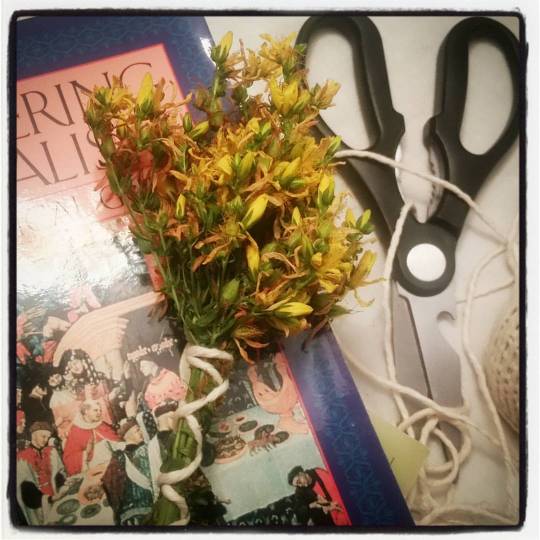
According to folklore, the plant is best plucked during Midsummer, on the Feast of St John, and can be burned on the Midsummer pyre to protect against witchcraft and bad luck. It can also be claimed as a talisman to navigate the Otherworld, and the juice can be used to anoint talismans and ritual tools for faerie work. It’s Latin name, Hypericum, means “power over spirits”. One might also hang a wreathe of it above their home or barn to protect against witchcraft, bad luck, and storms.
A Charm to Harvest St John’s Wort
SAINT JOHN’S wort, Saint John’s wort, My envy whosoever has thee, I will pluck thee with my right hand, I will preserve thee with my left hand, Whoso findeth thee in the cattle fold, Shall never be without kine.
Carmina Gadelica v2, 168
A Traditional Charm against Witchcraft
Trefoil, vervain, John’s wort, dill, Hinder witches of their will.
As a herb of fire, this herb is excellent for conditions that affect the nervous system, such as anxiety and terror. It is, traditionally, plucked with the right hand, and preserved beneath the left armpit to protect against these maladies. It was also, according to Culpepper, used as a remedy against melancholy and madness when taken internally.
Culpepper on St John’s Wort
A tincture of the flowers in spirit of wine, is commended against melancholy and madness. Outwardly, it is of great service in bruises, contusions, and wounds, especially in the nervous parts.
Culpepper’s Herbal
St John’s Wort is an astringent, expectorant, nervine, haemostat, and is hepatic. It is excellent for clearing excess phlegm from the lungs in cases of chronic bronchitis (Beyerl, Master Book of Herbalism). Care must be taken, as too much of this firey herb can make one’s skin sensitive to the sun. As such, the juice is known as Liquid Sunlight, and may be used in recipes to call upon solar deities, and spirits of fire, and to clear out through Holy Flame. It is best taken as a tea against depression during the darker half of the year when winter’s chill may set into the bones. Daniel Schulke in his book Viridarium Umbris gives a formula against melancholy to be made in the spring and summer months made from the flowers of violet, rose, gillyflower, primrose, and St John macerated in brandy.
St John’s Wort is a powerful, fiery faery herb, and is a great spirit to have around the house. It’s beautiful yellow flowers can be harvested all through the summer months, and are best harvested on a long, hot summer day.





 Heatherwitch